By John Benedict and Hal Harwell, Summer 2025
The Simmons Creek Colony began about 1867, when several African Americans purchased land here on the west side of Simmons Creek not far from what is now the small community of Kendalia, Texas. At that time, it was called the “Curry’s Creek Community.” As far as we know they were all former slaves. As this freedom colony population grew with the birth of babies in the five families, it eventually had a school.
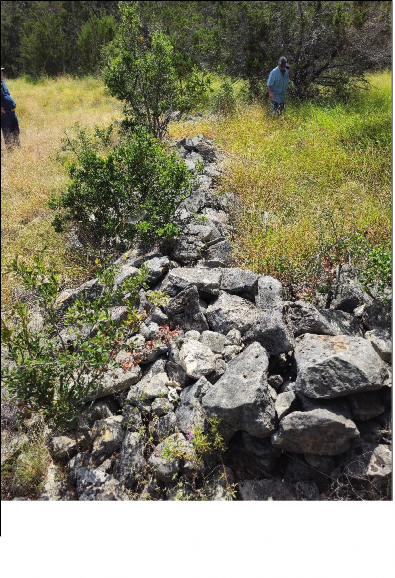
In 2025 we visited part of this former colony property. We could find no remains of the school or any homes or barns. The current landowners were unaware of any ruins of such structures. However, our survey was limited as we only visited a small portion of the original 553 acres that formed this colony. We were shown an area of stone walls that is believed to date to colony. These stacked field stone walls formed rectangular patterns suggesting use as animal pens, and/or protection to keep animals away from gardens and/or homes (Photo 1 and Figure 1). Most of these walls have collapsed over the past 150 or so years. We also found the remains of this colony’s cemetery, named the Simmons Creek Colony Cemetery (Figure 2). It is so overgrown with cedar trees that a good photograph is impossible.
The Simmons Creek Freedom Colony was well established by late 1870’s based on the US Census and deed records. At that time there were five families with a total of 15 men, women and children living here and recorded as farming. In the 1880 Census there were six families with a total of 37 folks living there. The 1890 Census records were lost. In the 1900 Census there were 7 families and 47 total African Americans living in the colony. However, in the 1910 Census there are only 3 families and 9 individuals remaining. We could find no evidence of any colony members living here in the 1920 census. I believe all the property had been sold by 1925 based on deed records.
The original colony land consisted of 7 adjacent properties totaling 553 acres.
This land was mainly acquired by these African Americans between 1870’s and 1880’s, most in 1873 from Marilla Perkins. The colony owners were:
colony still living there. https://www.txgenwebcounties.org/blanco/Cemeteries/peyton.html
The Simmons Creek Cemetery appears to have 9 total burial sites. It has 3 headstones, two made from limestone, without inscriptions, and one of grey polished granite that is clearly inscribed with Murray and Mahalie City’s names (See Photo 2). It is likely that Seborn Riley and his wife Harriet Riley, and Burrell Wren and his wife, Millie Riley, are buried in the unmarked graves in this cemetery. A death certificate shows that Hattie Gilmore, wife of Collins Gilmore was buried here, so I suggest that her husband, Collins Gilmore, is buried here also, both in unmarked graves. Lucy Gilmore is buried here based on her death certificate. This suggests her husband James Gilmore is buried here too. These 5 couples were most of the founding families, and likely account for the 9 burials we discovered in this cemetery. Also we may have missed at least one unmarked burial site.
Based on the Census records, the family names of those that lived in this colony were: City, Gilmore, Pulmer, Riley, Ware, Williams and Wren. Many individuals with these family names can be found in the cemeteries in the Peyton Colony in Blanco
County, and in the Wren Colony and Wasp Creek-Spanish Pass Colony in Kendall County, as well as the Tivy Mountain African American Cemetery in Kerr County, https://www.kerrvillerotary.org/Stories/history-of-tivy-mountain-cemetery and https://www.hccommunityjournal.com/article_56c77251-c85e-4176-9bc9- 5b3eadbd40d3.html
All that we could find of the Simmons Creek Colony today are the cemetery and an area of stacked fieldstone walls.
Photo 1. Stacked fieldstone in a feature that was likely part of a home site that was used as animal pens and/or garden fencing to keep animals out. This was likely made and used by one or more of the founding families of the Simmons Creek Colony.
Possible reasons for the colony dispersing and the land being sold are: 1) The founding individuals passing away or becoming too old to farm and ranch; 2) The younger family members leaving to find better schools, churches, jobs, a more welcoming community, and more exciting social life; 3) The Ku Klux Klan between 1915 and 1925 becoming very active, harassing and intimidating African Americans, especially in Texas rural communities; 4) Drought and the Boll Weevil making farming and ranching unprofitable: 5) The Jim Crow Laws in Texas making life for African Americans very difficult: 6) Cultures in the northern and western States that offering far more freedom, safety, enjoyment and economic opportunities for African Americans.
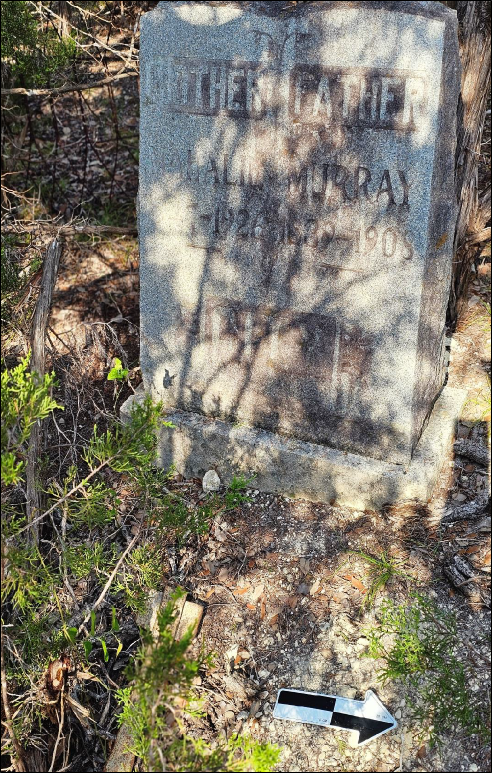
Photo 2. Grave site for Murray City, 1839-1908, and his wife Mahalie City, 1847-1926, one of the original founding families of the Simmons Creek Colony. The gravestone is a beautiful modern polished and etched gravestone made of grey granite.
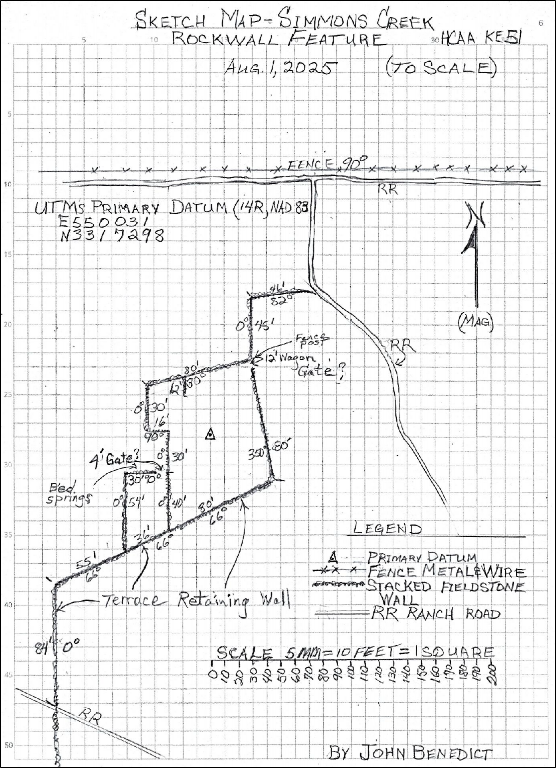
Figure 1. Scale sketch of the field stone walls that create a series of partially enclosed areas of various sizes and a terrace retaining wall. This feature is believed to have been built by the original inhabitants of the African American Freedom Colony that began here in 1870’s and ended about 1925.
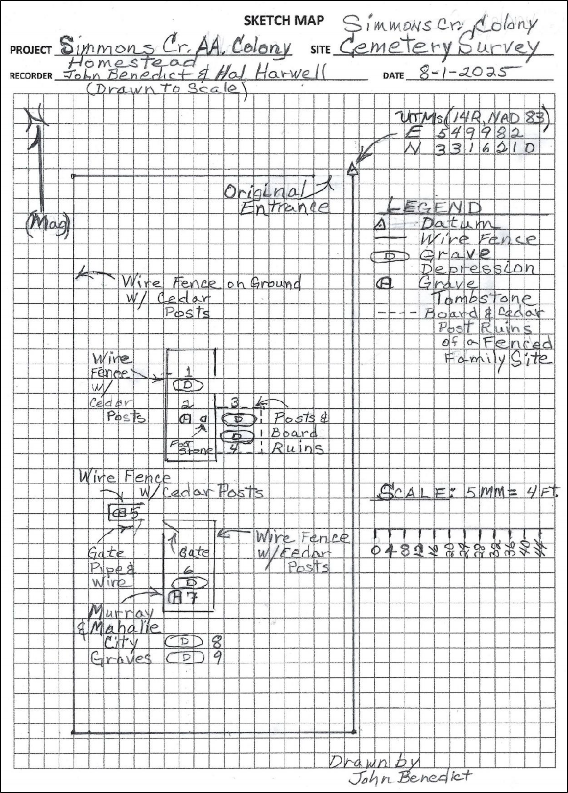
Figure 2. Sketch map of Simmons Creek Cemetery showing location of 9 grave sites. Sites 6 & 7 are for Mahalie and Murray City.